


2. Muhammad Shah Alam : a son of Burhan al-Din who was the founder of Bukhariya Saiyid, and his group had a great religious influence in the Gujarati region and were respected by the ruling class of the Ahmad Shahi dynasty. His dargah consisting of the tomb of Shah Alam, a mosque, tombs and Jama'at Khana (Assembly Hall) is the most famous religious centre among those still venerated by religious Muslims in Gujarat.
From the historical Persian inscription hung at the entrance to the tomb, it can be assumed that the saint died in 880AH (1475). This inscription also mentions that his tomb was constructed in 888AH (1483), and the name of a noble who constructed the tomb is written. As Dr. Rajan stated, there remain various buildings built between 1475 and 1575 in the Dargah of Shah Alam. Among all, two mausoleums and Jama'at Khana, which will be introduced below, are the main buildings.
The tomb of the Sayid Shah Alam is situated roughly in the centre of the east end of this dargah. It is a majestic building on a square plan with a 12-pillared mausoleum with a high dome in the centre of the roof, surrounded by double corridors with 24 small domes on top. It has arch-shaped entrance on all sides. The main entrance on the west having a small dome projects out from the wall. On each wall of the mausoleum, there is an entrance in the centre. On either side of the entrance, there are three arch-shaped windows, over which an arch-shaped part covered by Jali Screen is formed. It helps giving dignity to this mausoleum. When I visited the site, all domes on the roof was painted in white, suggeting that this dargah is still venerated.

?To the west-southwest facing the tomb of Shah Alam, there remains the tomb of Saiyid Makhdum 'Alam. The size, form and structure of the tomb is roughly same as the above tomb. Saiyid Makhdum 'Alam is said to have been the 6th grand son of Shah Alam. This mausoleum also has the entrance projecting out to the east. 24 small domes on the roof are very prominent in this building. Unlike the tomb of Shah Alam, the domes were not painted in white, which conversely gave me strong impression. Inside of this mausoleum is filled with tomb stones. What struck me most was the Jali screen employed on the walls of this squre building. Every pattern was different. I was surprised by the variety of the patterns.
?To the north of this mausoleum, there is a mosque built in the west-northwest of the tomb of Shah Alam. It was constructed later in history. Having an open space with a pond in front of the main building, the noble structure of this construction is quite distinctive. Inside of the prayer room, having a transition with unique sculptures and patterns and mihrab forming simple circular arches, creates unique atomosphere. According to Dr. Rajan, this mosque was constructed by a person called Najabat Khan in the early 17th century and the construction was completed by a person called Saif Khan in 1620. The scluptured patterns on the surface of high and slender minarets on either side of the mosque seemed to me prominently unique.


 Situated in Kankhal, one of five sub-cities of Haridwar, the ashram houses the smaadhi shrine of Sri Anandamayi Ma (1896-1982), a noted saint of India.
  This Bird Sanctuary is situated on the main Ganga river, or Neel Dhara, at the Bhimgoda barrage, it is a paradise for bird watchers and home to many migratory birds during the winter season.
  According to Mythology the seven sages- Kashyap, Vashisht, Atri, Vishvamitra, Jaindayani, Bhardwaj and Gautam-were deep in meditation here. The Ganga, not wanting to disturb them and facilitating each her easy approach prefer rather split herself into seven channels around each Rishi.
  A multi-storey temple, dedicated to Bharat Mata, Mother India, with each floor depicting an era in the Indian History, from the days of Ramayan till India's independence.
  Haridwar is also a popular destination for nature and adventure lovers. The Rajaji National Park is about 820 sq. km. in area; attracts wildlife lovers with its pristine scenic beauty and rich bio diversity. Three sanctuaries of the Shivalik range of western U.P. - Rajaji, Motichur and Chilla were amalgamated into a large protected area and named Rajaji National Park in year 1983. It has 23 species of mammals and 315 avifauna species. One may watch a herd of elephants roaming majestically in the jungle or may find oneself excited by wildlife of many kinds including tigers, leopard, jungle cat, Himalayan yellow throated marten, samber, cheetal, barking deer, wild boar, langoor, ghural, sloth beer, king cobra, woodpecker etc. The river shelters fish in abundance.
 Shantikunj was founded by the Saint-Scholar-Philosopher par excellence, Pandit Shriram Sharma Acharya, who in his youth was also a freedom fighter.
 Situated in Harihar Ashram, Kankhal. Shivling weighing about 150 kg and Rudraksha tree are main attractions here.
  Bhimgoda Sarovar or tank is at a distance of about 1 km from Hari-ki-Pauri. It is said that while Pandavas were going to Himalayas through Haridwar, Bhim made this tank with the blow of his knee.
  Temple of Goddess Sureshwari, situated in midst of beautiful Rajaji National Park. Serene and religious makes this temple abode of worshipers, saints etc. Located at outskirts of Haridwar in Ranipur and permission from forest rangers is necessary.
  According to Indian Mythology the army chief Chanda-Munda of a local demon King Shumbh- Nishumbha was killed by goddess Chandi here after which the place got the name Chandi Devi .
  The temple of Chandi Devi at the top of Neel Parvat on the other bank of river Ganga was constructed in1929 A.D. by the King of Kashmir-Suchat Singh. It is 3 kms. trek from Chandighat. It is believed that the main statue was established by the Adi Shankaracharya in 8th century AD. It is situated at a distance of 6 kms. on Neel Parvat on the other bank of the main Ganga river. Cable car service is available to reach the temple if one can not climb on foot.
  The temple of Goddess Mansa Devi is situated at the top of Bilwa Parwat (Bilwa mountain). People with a lot of faith climb the top of the mountain to reach the temple on their feet. Here one statue of the Goddess has three mouths and five arms while the other statue has eight arms. The beautiful view of the city can be seen from this place. There is also available a cable car service (ropeway) to take devotees to the old hilltop of Mansa Devi.
  This sacred Ghat was constructed by the king Vikramaditya in the memory of his brother Bhratrihari. It is believed that Bhratrihari eventually came to Hardwar to meditate on the banks of holy Ganga. When he died, his brother constructed a Ghat in his name which later came to be known as Har-Ki-Pauri. This sacred bathing ghat is also known as Brahamakund. The reflection of golden hues of floral diyas in the river Ganga is the most enchanting sight in the evening during the Ganga Aarti (Worship). The ghat is regarded as the most sacred in Haridwar and this is the most auspicious point to bathe in the Ganga. A clock tower was also constructed here by Seth Birla which is worth watching.
  The 'Dargah' of Hazrat Makhdum Allauddin Ali Ahamed 'Sabir' on the outskirts of Roorkee town is a worth-visit-place for every visitor. It is situated towards the south of Haridwar. This place is one of the living examples of unity between the Hindu and Muslim religions. Famed for its mystical powers that fulfill the desires of the devout, the Dargah is visited by millions of devotees from all religions from India and abroad. The Urs is celebrated at this Dargah every year, from the first day of sighting the moon to the sixteenth day during the Rabeeull month of the Islamic calendar.


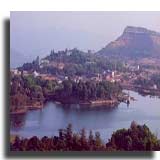
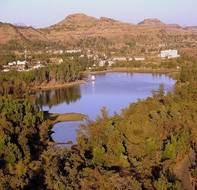


 Located in the heart of Porbandar city, this small bird sanctuary approximately 1sq km in area is home to a variety of wildfowl, teals, ibis, curlews, and a sizeable number of migratory birds.
 Gujarat's picturesque hill station is perched on a plateau at an altitude of about 1000m in the Dang forest area of the Sahyadari Range. It has a cool bracing climate, the highest temperature even in the summer months not exceeding 28 degrees Centigrade. Saputara is situated 160 kms from Surat. Legend has it that Lord Rama spent 11 years of his exile in these very forests.


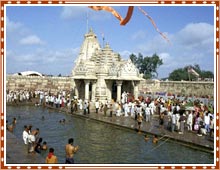 Tarnetar Mela is one of the most popular fairs of Gujarat. It is organized in a village called Tarnetar, situated at a distance of around 75 kilometers from Rajkot. It is an annual three day fair and is celebrated during the months of August-September and is also called the Trinetreshwar Mahadev Fair. Tarnetar Mela is an important fair for the tribal people of India and is therefore thronged by all the nearby tribes of the region. The major tribes which participate in this fair are Koli, Bharwad, Rabari, Khant, Kanbi, Kathi, and Charan.
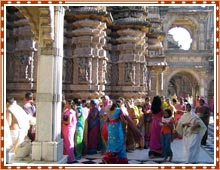 Gujarat boasts of a rich culture and heritage. The people of Gujarat are commonly referred as Gujaratis and the main language spoken by them is Gujarati. Gujarat is a flourishing state in all spheres and as a result, numerous people from different parts of India have settled here for various reasons like trade, education, etc. Though, with changing times the state has prospered and is on the path of development, its people are strongly bound by their ancient value system.